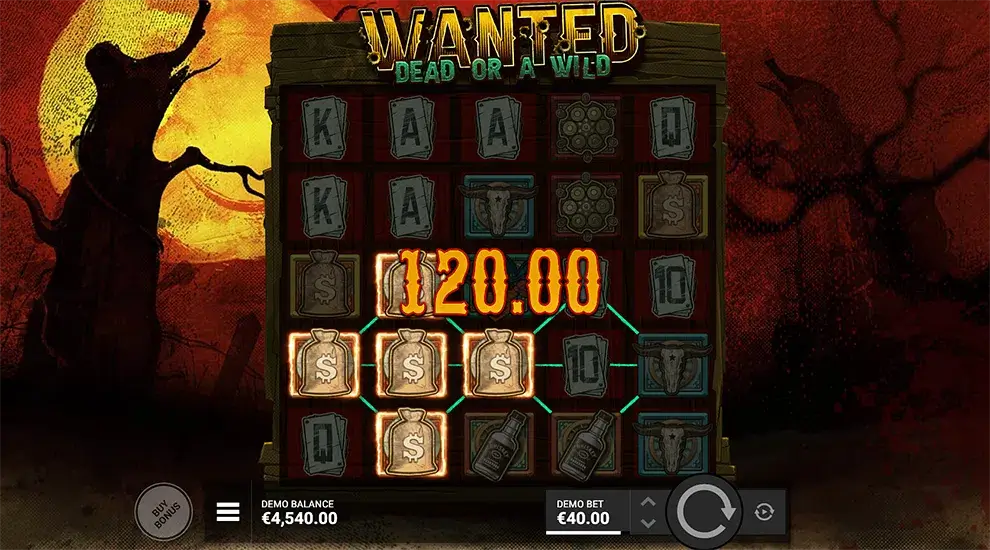
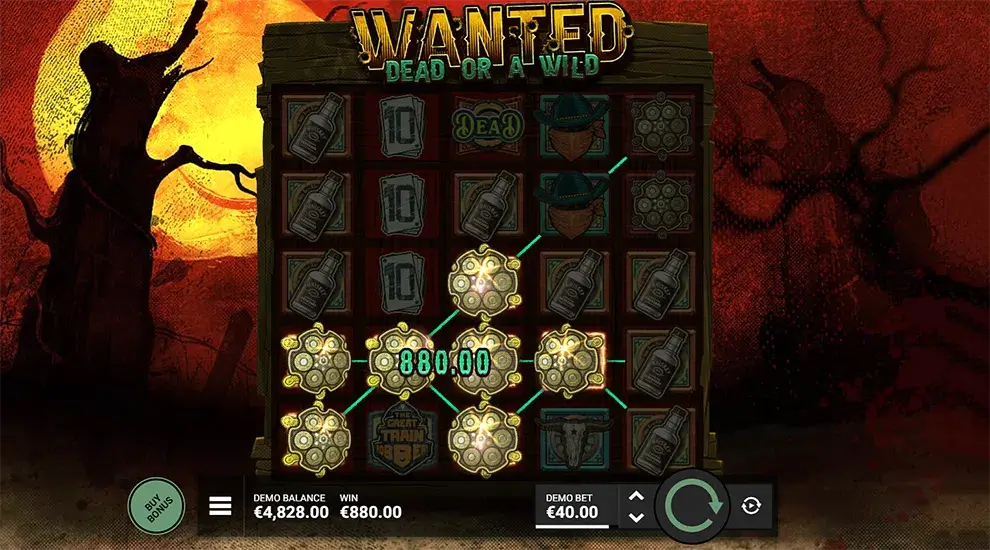
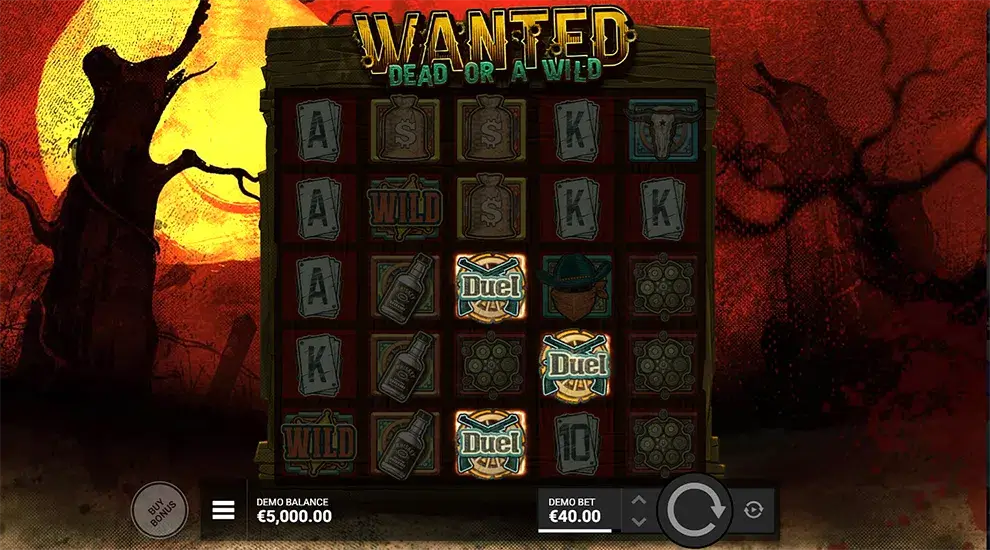
The first rule of any slot strategy is understanding its limitations. When playing Wanted Dead or a Wild, no strategy can alter the RNG, predict a bonus trigger, or budge the game's hardcoded 96.38% RTP. What a solid strategy can do, however, is keep you in the game long enough for high variance to work in your favor rather than wipe you out.
That distinction matters more here than on almost any other slot. Wanted Dead or a Wild plays out on a 5x5 grid with 15 paylines and a tight 19.36% hit frequency. In plain terms, four out of every five spins yield absolutely nothing. With a massive 12,500x maximum win potential, the base game is intentionally brutal. Dry spells of 40 to 60 spins between bonus features are standard variance, not a game malfunction. The first time I played without realizing this, I tilted, spiked my bet size after a 30-spin drought, and incinerated half my bankroll before a bonus finally landed. The second time around, I kept my stakes flat, exercised patience, and let the Dead Man's Hand Showdown pull me firmly into the black. The difference wasn't luck-it was disciplined session management.
Understanding the Odds in Wanted Dead or a Wild
Before any betting system can safeguard your bankroll, you must grasp how these metrics translate into a live session. Most players skip this step and pay the price within their first 20 spins.
A 96.38% RTP means that over millions of simulated spins, the game returns 96.38 units for every 100 wagered. It absolutely does not guarantee a 96.38 return on a single 100-unit session. In a short window of 100 to 300 spins, actual returns can swing wildly in either direction. On a game rated 4 out of 5 on the volatility scale, those swings are wide enough to trigger total liquidation or massive windfalls within the exact same statistical framework. Accepting this volatility before pressing "Spin" is the foundation of any viable strategy.
A 19.36% hit frequency means any winning combination-even a micro-return of 0.1x your bet-lands roughly once every five spins. Crucially, this is not the frequency of meaningful payouts; it is the rate of any win at all, including negligible returns that barely register. The actual gaps between high-value combinations, bonus triggers, or premium symbol connections are significantly wider. In my test sessions, I frequently tracked stretches of 12 to 15 spins without a single payout above 1x, which is the realistic rhythm you are managing against, not the theoretical 19% average.
Hacksaw Gaming doesn't publish the exact trigger odds for individual bonus rounds. In practice, weathering 40 to 80 base-game spins without a feature is completely normal. Sizing your bankroll around the reality of an 80-spin dry spell is far smarter than banking on a statistical average-because that average includes lucky sessions where a bonus hits on spin 12 and horror stories where it takes 120. Your budget must survive the latter.
Bankroll Management for Wanted Dead or a Wild
On a high-volatility machine with a sub-20% hit frequency, bankroll management isn't a helpful tip-it is the strategy. Every betting system, feature purchase, or Bonus Buy decision operates strictly within the boundaries your bankroll dictates. Without hard limits defined upfront, extended dry runs will force your hand, usually leading to chased losses and inflated bets. Both accelerate the journey from a bad run to a cleared-out balance.
How to Size Your Bets for This Slot
Stake sizing is the core mathematical engine of your session. The interplay between bet size, session length, and bonus access determines whether variance works for you or destroys you before the reels even turn. Let's break down the real numbers.
A 100-unit starting budget at a 1.00 stake buys you 100 spins. Given the 19% hit frequency, roughly 81 of those spins will lose. If you hit an ordinary 80-spin dry spell, your entire budget is wiped out in the base game without ever seeing a feature. Cutting your stake to 0.50 yields 200 spins, doubling your statistical window to trigger a bonus. Drop down to 0.20, and you secure 500 spins, while a Bonus Buy for The Great Train Robbery drops from a steep 80 to a highly accessible 16.
The gold standard for Wanted Dead or a Wild is risking just 1% to 2% of your total session bankroll per spin. With a 50 budget, that means staking between 0.50 and 1.00. With 200, scale it between 2.00 and 4.00. This conservative sizing keeps you in the game long enough to trigger features naturally, while ensuring a disappointing bonus payout doesn't instantly end your night.
Practical Bankroll Tips
Establish a strict loss limit before opening the game. Choose an absolute maximum you are willing to lose and close the slot the moment you hit it, regardless of your intuition. On a game where 40 consecutive dead spins is standard behavior, the feeling that a win is "due" is a dangerous illusion. Variance doesn't care about your schedule.
Keep your stakes bound to the 1%-2% rule. For a 40 budget, stick to 0.40 to 0.80 per spin. This ensures you have the runway to absorb base-game dry spells and reach the bonus rounds alive.
Lock in your profits with a clear win target. If your balance jumps by 50% or more, either walk away or drop to the absolute minimum bet. Securing a tangible win beats risking it all on high-variance spins trying to force a bigger score.
Never attempt to chase losses. A losing streak on a volatile slot is not evidence of a looming correction. The RNG has no memory and owes you nothing. Raising your stakes to claw back losses is the fastest way to burn through your remaining funds without shifting the odds of the next spin by a single fraction.
Rely on flat betting as your baseline. Keeping your bet size identical across the session is the safest approach to this level of volatility. Progressive betting systems offer a false sense of structure but expose you to catastrophic downside during the long, deliberate dry runs built into this game's DNA.
Bonus Round Comparison
This is what most players looking for a strategy are actually trying to solve. The three bonus features are completely different beasts. Each has its own volatility profile, entry cost, adjusted RTP, and payout expectations.
Feature
Volatility
Bonus Buy Cost
Bonus Buy RTP
Max Potential
Best For
The Great Train Robbery
Medium
80x bet
96.43%
Moderate, consistent
Bankroll preservation, first-time buyers
Duel at Dawn
Very High
200x bet
96.27%
Highest ceiling via VS chains
Chasing 12,500x, high-risk sessions
Dead Man's Hand
High
400x bet
96.38%
Extreme when Collect runs long
Advanced players, large bankrolls
Bonus Round Comparison
The Great Train Robbery: Best Value for Consistent Play
Ten free spins with sticky Wilds that lock onto the reels, compounding your wins for the rest of the round. This is the lowest-volatility feature and the most forgiving entry point for bonus hunters. By spin 6 or 7 of a solid run, a significant portion of the 5x5 grid locks down, causing payouts to scale exponentially. Target this feature when your priority is steady bankroll preservation over chasing rare, astronomical caps.
At 80x your stake, it also represents the most cost-effective Bonus Buy. A 0.20 bet requires just a 16 purchase; a 1.00 bet costs 80. For players executing a structured bonus hunt, opening with two or three Great Train Robbery buys is an excellent, lower-risk strategy to build a safety cushion. Furthermore, its 96.43% Bonus Buy RTP is the highest of the three options, making it the most mathematically efficient choice for paid entry.
Duel at Dawn: Best Route to Maximum Win
Ten free spins where VS symbols land at a drastically higher frequency than in the base game. This is the most volatile feature on offer and the most unpredictable on a session-by-session basis. A single lucky spin featuring three expanding VS symbols with combined multipliers soaring past 60x can define an entire session. Conversely, a feature where multipliers fall flat and symbols fail to align can easily return next to nothing.
At 200x your stake, you need to budget for at least two to three purchases to let variance level out. Buying a single Duel at Dawn round is a pure lottery ticket; buying three gives you a much more realistic statistical sample. If you are strictly hunting the 12,500x max win, this is your primary vehicle, as the increased frequency of VS symbols creates the multiplier chains required to shatter the game's ceiling.
Dead Man's Hand: Highest Ceiling, Highest Complexity
The most mechanically intricate feature in the game, split into two distinct, sequential phases. The Collect Stage operates on a respin counter that resets whenever a Wild or multiplier symbol lands, allowing you to stack up to 20 Wilds and a massive combined multiplier of up to 31x. Once the counter hits zero, the Showdown phase triggers, granting three ultra-high-value spins where all collected Wilds are randomly scattered onto the grid and multiplied by your accumulated total.
At a steep 400x your stake, a single entry at a 1.00 bet demands a 400 commitment. A premature collapse during the Collect phase followed by three disappointing Showdown spins is a very common reality, not an anomaly. You must have the bankroll to absorb multiple attempts before adopting this feature as a core strategy. However, when the Collect phase builds a massive stack, no other bonus feature comes close to matching its explosive upside.
Which Bonus Should You Buy?
Conservative bankroll / First-time session: The Great Train Robbery (80x). Reliable behavior, lowest entry cost, and the highest Bonus Buy RTP at 96.43%. It rarely completely blanks.
Max win hunters with a substantial bankroll: Duel at Dawn (200x) scaled across multiple entries. The VS multiplier chains provide the highest single-spin ceiling and the most direct path to 12,500x.
Advanced players with deep pockets: Dead Man's Hand (400x), budgeting for at least three entries. Offers unparalleled upside if the Collect stage runs deep, but devastating variance if it falls short early on.
Structured bonus hunts: Diversify your purchases across the session. For example, purchase two Great Train Robberies, two Duels at Dawn, and one Dead Man's Hand. Mixing volatility profiles protects your balance from hitting a uniform wall of bad variance.
Know Your Player Type Before You Set Your Bet
Your ideal strategy depends entirely on your session objectives. Three distinct personas approach Wanted Dead or a Wild differently, requiring entirely unique configurations for stake sizing, feature prioritization, and Bonus Buy usage. Identifying your player type before spinning is a core tactical requirement, not an afterthought.
Casual Player: Session Length Over Ceiling
Goal: Maximize entertainment and playtime within a strict budget, experience all three bonus features, and keep financial exposure to a minimum.
Keep your stakes strictly between 0.20 and 0.50 per spin. Set up Autoplay with a cumulative loss limit in the advanced settings matching your total session budget. Steer clear of Turbo mode; fast spins simply accelerate your losses during dry spells without boosting your bonus payouts. Your primary target is The Great Train Robbery. At a 0.20 stake, a Bonus Buy is highly accessible at 16, offering stable returns and a very low risk of a total blank. A 100 budget at 0.20 per spin yields 500 base-game spins, five full feature purchases, or a balanced mix of both.
High-Volatility Player: Maximum Ceiling, Accepted Risk
Goal: Hunt the absolute maximum payout possible, with full acceptance of the high probability of a total bankroll wipeout.
Position your base stake at a level where Bonus Buys remain accessible for multiple rounds without breaking your bankroll on a single bad feature. At a 1.00 base bet, Duel at Dawn requires 200 per buy; at 2.00, it jumps to 400. Ensure your bankroll can comfortably weather two or three consecutive sub-par results. Duel at Dawn is your go-to feature, as its explosive VS multiplier mechanics generate ceiling-level wins faster than any other option. You can utilize Turbo mode to cut through the base game when hunting natural triggers, provided you accept that this fast pace will burn through capital rapidly during dry runs.
Bonus Hunter: Efficiency and Feature Access
Goal: Trigger or purchase bonus features as efficiently as possible, shifting exposure away from prolonged base-game grinds and directly into high-return mechanics.
At a 0.50 stake, entry costs scale predictably: The Great Train Robbery costs 40, Duel at Dawn is 100, and Dead Man's Hand is 200. A 500 bankroll gives you immense flexibility-allowing for 12 Train Robbery entries, five Duel attempts, or two Dead Man's Hand buys with plenty of capital left over for base-game spins. Spreading your budget across different features helps diversify your risk across varied volatility profiles rather than risking everything on a single expensive purchase.
Reading the VS Symbol During Base Game Play
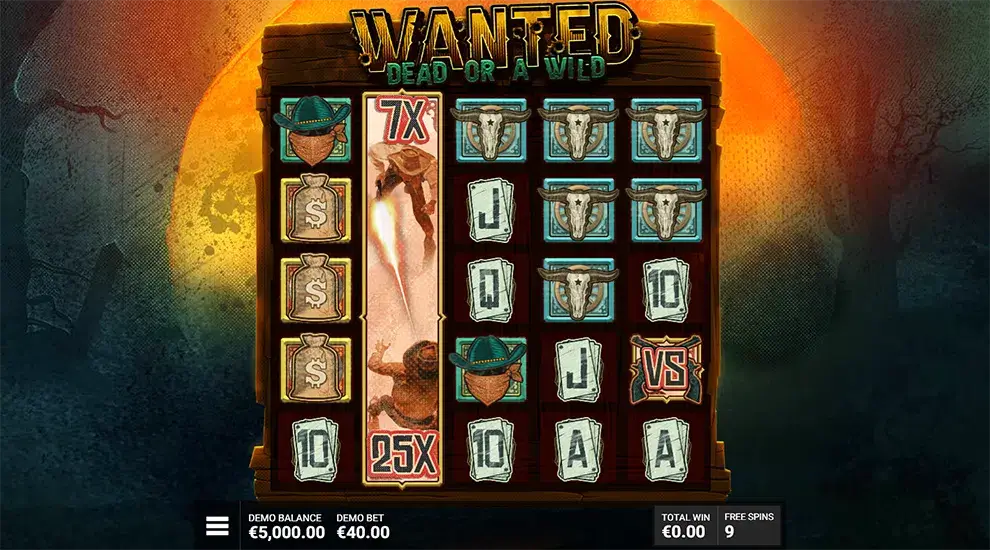
The VS symbol is the primary mechanic driving the base game's potential. When it lands, it expands to cover the entire reel, turning it completely Wild and initiating a duel between two random multipliers ranging from 2x to 100x. If multiple VS symbols land on a single spin, their values aggregate before being applied to your line wins-this is exactly how the base game generates massive, screen-clearing payouts outside of the bonus rounds.
Through rigorous tracking across my sessions, I observed a VS expansion roughly once every 20 to 30 spins on average. However, variance ensures this fluctuates wildly-from hot clusters of three expansions in five spins to daunting ice ages spanning 40 spins or more. A healthy session feels highly engaging and mechanically active. Conversely, a run of 40+ spins without a single VS expansion signals a severe dry spell that seasoned players quickly learn to recognize.
While the RNG has no memory and a cold streak doesn't dictate future outcomes, it does indicate that the base game isn't currently generating the friction needed for solid payouts. If your bankroll permits and the option is open, transitioning to a direct Bonus Buy rather than bleeding funds through a cold base game is a smart tactical pivot. During one of my sessions, after a 45-spin VS drought, I bypassed the base game to buy Duel at Dawn, which paid off handsomely within its first three spins. While this is correlation rather than causation, the underlying bankroll preservation logic remains flawless.
Practical Tips and Common Mistakes
Common Mistakes on Wanted Dead or a Wild
Misinterpreting dry spins as a visual cue. Going 40 spins without a meaningful win is completely normal for a 19% hit frequency game under standard mathematical variance. Assuming a big win is "overdue" and raising your bet is the single fastest way to destroy your session. I fell into this trap during my very first session, and it vaporized half my capital before the bonus finally arrived.
Chasing losses with progressive stakes. This is a catastrophic mistake on a highly volatile Hacksaw title. The RNG is emotionless, carries no memory, and has zero obligation to correct a cold streak. Raising stakes simply accelerates your path to a zero balance.
Combining Turbo mode and Autoplay without strict limits. Speeding up your spins is not a strategy. It simply shortens the time it takes to reach the game's theoretical outcome, which usually means draining your balance much faster than playing manually.
Buying Dead Man's Hand on a single-entry budget. At 400x your stake, a 1.00 bet requires a 400 buy-in. A brief Collect stage followed by a flat Showdown is highly common. Either ensure your bankroll can cover multiple attempts, or drop your unit size until multiple entries fit your budget safely.
Failing to check the active RTP variant. Many operators configure this slot at a downgraded 88.42% RTP. The difference between that and the optimal 96.38% version compounds brutally over time. Checking the paytable takes ten seconds but fundamentally alters your long-term survival rate.
Ignoring casino bonus wagering terms. Clearing a deposit bonus with a 40x wagering requirement inside a tight window on a high-volatility, low-hit-frequency game is incredibly difficult. It demands massive volume or a legendary bonus payout. Always read the fine print before tying your bankroll to a bonus on this game.
Betting Strategies for Wanted Dead or a Wild
Betting systems give your session a clean structural framework, but they cannot alter the game's RTP, hit frequency, or individual spin probabilities. On a slot like Wanted Dead or a Wild, where long losing streaks are features, not bugs, a system's true worth is measured by how it mitigates losses during downturns. Any system that forces aggressive upscaling during a 15-spin losing streak is fundamentally dangerous here, regardless of its performance during a hot streak.
Flat Betting
The undisputed gold standard for Wanted Dead or a Wild. You maintain the exact same stake on every single spin, with zero adjustments after wins or losses. Keeping your stake uniform provides the sturdiest defense against extreme volatility.
Why it works beautifully here: Since 81% of your spins result in losses, progressive systems that scale up bets on a loss rely on a fundamentally flawed assumption that a win is imminent. Flat betting removes this trap, ensuring your budget depletes at a perfectly predictable pace while maximizing your total number of opportunities to trigger a major feature.
Flat betting example with a 40 session budget:
Set your bet to 0.40 (exactly 1% of your total bankroll).
Maintain this 0.40 stake on every single spin, regardless of short-term streaks.
Under standard variance, an unlucky 63-spin stretch without a feature will only deplete your balance by roughly 5 to 8 units.
When a bonus feature lands and delivers a strong return, lock away a set portion of those winnings before continuing at the baseline stake.
During a 90-spin test session using a flat 0.40 stake, I triggered The Great Train Robbery on spin 67 after an incredibly dry run. The sticky Wilds built up perfectly by spin 8, resulting in a 31 payout. Because I resisted the urge to increase my stake during the dry spell, I still had 23 of my original bankroll intact when the feature hit. Had I aggressively ramped up my bets to chase losses, my balance would have evaporated before spin 50, causing me to miss the winning feature entirely.
Reverse Martingale
This system dictates raising your bet after a win and dropping back to your base stake after a loss. The logic is simple: capitalize heavily on hot streaks while minimizing exposure to your base unit during cold runs. Given the 19% hit frequency, you will spend most of your session at the base bet, protecting your bankroll during dry stretches while allowing clustered wins to scale aggressively.
Reverse Martingale execution starting at 0.40:
Bet 0.40. If it wins, increase the next bet to 0.80.
If it wins again, ramp the next stake to 1.60.
If it wins a third time, step up to 3.20.
Any single loss at any step immediately resets your stake back to the 0.40 baseline.
In sessions where I successfully reached step three before a loss, the net return remained heavily positive upon reset. The capital used to scale bets in steps two and three came directly from previous wins rather than my initial bankroll. Downside is rigidly capped at your base unit, while your upside climbs during hot streaks. On a slot where wins are rare but highly explosive (due to clustered VS symbols or feature triggers), this structure aligns beautifully with the game's mechanics.
Martingale: Why It Fails on High-Volatility Slots
The classic Martingale strategy demands doubling your bet after every single loss, returning to the base stake only after a win. The theory is that a single winning spin completely erases all accumulated losses and locks in a profit equal to your original unit. While this logic functions on near-50% probability games like Roulette, applying it to a 19% hit frequency slot is a recipe for instant ruin.
Martingale breakdown starting at 0.50:
Lose a 0.50 bet. Next stake: 1.00.
Lose a 1.00 bet. Next stake: 2.00.
Lose a 2.00 bet. Next stake: 4.00.
Lose a 4.00 bet. Next stake: 8.00.
Result: Five consecutive losses cost you 15.50, requiring a massive 16.00 bet just to break even.
A five-spin losing streak isn't an anomaly on a 19% hit frequency slot-it's a routine occurrence you will face multiple times per session. After just five dead spins, the stake required to recover your losses already eclipses the starting bankroll of most casual players. When I stress-tested this system on Wanted Dead or a Wild, I ran into a nine-spin dry spell almost immediately. By spin nine, the required bet exceeded the casino's maximum allowable table limit, causing the system to collapse catastrophically.
The math doesn't lie. With 81% of spins returning absolutely nothing, the Martingale assumption that a win will arrive in time to save your bankroll is statistically invalid. Is Martingale a viable strategy here? Absolutely not. That conclusion is a mathematical certainty, not a personal preference.
The 1-3-2-6 System
A structured four-step betting progression applied strictly across consecutive wins. The numbers represent multipliers of your base stake, resetting to the baseline step after any loss.
System example with a 0.80 base bet:
Win at baseline. Next bet: 0.80 (1x base).
Win again. Next bet: 2.40 (3x base).
Win again. Next bet: 1.60 (2x base).
Win again. Next bet: 4.80 (6x base).
Any loss at any point instantly resets the next stake back to 0.80.
Whenever a session advanced to step three before a loss, the net balance remained firmly in the black before resetting. The smart 2x reduction at stage three lowers your active risk right before the high-exposure 6x final step, meaning a loss at the final hurdle hurts significantly less than it would under a standard doubling progression. For players who find flat betting too conservative but recognize that Martingale is financial suicide on a volatile slot, this system offers an ideal middle ground-scaling wins dynamically without creating unchecked downside during standard dry runs.
Session Plan for Wanted Dead or a Wild
Verify the RTP variant before depositing any funds. Pull up the game's internal paytable. The premium version displays a 96.38% RTP. Anything under 95% indicates a downgraded model-walk away and find another casino. Spending ten seconds on this verification completely alters your long-term survival metrics.
Establish your stake and total bankroll via the 1% to 2% rule. A 0.50 bet on a 100 bankroll yields 200 base spins or 40 Train Robbery entries. A 1.00 bet offers 100 spins or 80 entries. Only Deposit what you have completely allocated for this specific stake setup.
Run a 30- to 50-spin trial in demo mode first. Gauge the current VS symbol behavior and overall rhythm before putting real money on the line. If the demo exhibits zero VS activity over 50 spins, expect a cold base game early in your real session and budget accordingly.
Lock in your Autoplay boundaries before hitting start. Set a strict cumulative loss ceiling equal to your total session budget. Add a single-win cap if you plan to walk away after a major feature payout. Never run Autoplay on this title without both safety nets active.
Commit to your baseline stake throughout the base game. The plan you build before spinning must govern the session. Tweaking your bets mid-run out of frustration or greed is a knee-jerk reaction to variance that accelerates losses without shifting the game's core probabilities.
Bank a fixed percentage of any major bonus windfall immediately. Once a feature delivers a massive payout, scale down to the absolute minimum bet for the subsequent base-game run. The ultimate pitfall is riding a high and maintaining inflated stakes under the false assumption that a hot streak will last forever.
Exit the game the second you hit a pre-determined boundary. Whether you hit your win target or your loss limit, close the slot immediately. Every single session extended past these limits ends up bleeding chips. That isn't a coincidence-it's exactly what high-volatility slots are engineered to do to players who overstay their strategy.
The Honest Summary of How to Win at Wanted Dead or a Wild
Wanted Dead or a Wild presents a transparent mathematical reality: a 19% hit frequency, a baseline 96.38% RTP, and a staggering 12,500x max potential. No playing style can alter these constants. What you can control is the efficiency with which your bankroll navigates the punishing base game until a feature triggers, and how disciplined you are at locking away profits rather than instantly feeding them back into a highly volatile engine.
The ultimate strategy for any high-volatility slot is uncompromising consistency. Execute flat betting at 1% to 2% of your bankroll. Verify the RTP before placing a single bet. Use demo mode to calibrate your expectations. Enforce strict Autoplay limits before turning on high-speed modes. And anchor yourself to an absolute exit point.
None of these tactics will rewrite the house edge. Instead, they masterfully manage variance, giving the game's explosive bonus features the space they need to land while your bankroll is still alive to capitalize on them. Every successful session I've logged on this slot strictly honored this blueprint; every catastrophic failure broke it. This isn't a guaranteed cheat code-it is simply the most robust, battle-tested framework this slot allows.
FAQ
At what bankroll size does Bonus Buy make sense on this slot?
Bonus Buys only make sense if your session bankroll can weather multiple consecutive misses without wiping you out. As a rule of thumb, you need a bare minimum of three entries for your chosen feature. At a 0.50 stake, The Great Train Robbery costs 40 per buy, meaning a 120 budget gives you exactly three shots. Duel at Dawn (100 per buy) requires 300, while Dead Man's Hand (200 per buy) demands 600. If your balance can't cover three buys at your current stake, either drop the base bet or pick a cheaper feature. I learned this the hard way on my first Dead Man's Hand buy at a 1.00 stake. The Collect Stage choked on the third respin with just four Wilds, and the Showdown paid peanuts. Blowing 400 on a single feature buy with zero backup isn't a strategy-it's just a single spin masquerading as a session. On a slot this volatile, that mistake will cost you real money.
Which bonus round has the highest win potential?
Duel at Dawn offers the most direct path to the 12,500x max win. VS symbols land far more frequently during this feature; if multiple symbols expand on a single spin with combined multipliers scaling past 60x, one lucky spin can define your entire session. On paper, Dead Man's Hand has the highest theoretical ceiling-assuming a long Collect Stage where you stack up to 20 Wilds and a 31x multiplier before the Showdown. In practice, though, Duel at Dawn delivers extreme payouts more consistently because those VS multiplier chains can compound beautifully across all 10 spins, regardless of how the round starts. Dead Man's Hand can trigger massive single-session payouts when everything aligns, but that alignment relies entirely on a prolonged Collect Stage-something you can neither influence nor predict. My personal best in demo mode came from a Dead Man's Hand run where the Collect Stage racked up 14 Wilds, yielding a Showdown worth over 2,000x. But the three sessions right before that? They bricked early and returned under 20x each. That wild variance is the honest truth of this game.
Should I use the demo mode as part of my strategy?
Absolutely, and not just to learn the rules. Spinning 30 to 50 rounds in demo mode before risking real money gives you a feel for how the VS symbols are behaving and the general rhythm of the base game. A demo run that triggers two bonuses and active VS expansions within 50 spins sets a completely different psychological expectation than a session that runs completely ice-cold over the same sample size. Granted, the RNG uses the exact same math distribution in both versions, making demo behavior a great calibration tool before tapping into your real bankroll. I always run a quick demo session before playing high stakes. It won't tilt the odds in your favor, but it calibrates your patience threshold before that first real spin-which, on a slot with a brutal 19% hit frequency, matters just as much as your bet sizing.
Are there any cheats, hacks, or guaranteed win systems for Wanted Dead or a Wild?
No, and I say that as someone who has logged enough hours on this slot to know exactly where that temptation comes from. After an agonizing 60-spin cold streak with zero bonus triggers and a bleeding balance, any claim about 'hidden patterns' or 'timing tricks' starts to sound appealing. Don't fall for it. Wanted Dead or a Wild relies on a strictly certified RNG (Random Number Generator) that produces completely independent results on every single spin. What happens on spin 100 has zero statistical connection to spin 99. No software, exploit, betting pattern, or third-party tool can predict or alter the algorithm. Any site or service promising guaranteed wins or hacks for this game is a flat-out scam. The only variables under your control are your bet size, session length, and targeted bonus features. Everything else is pure variance, and variance cannot be hacked.
Can you hit the 12,500x maximum win in demo mode?
Yes, it can. The demo version utilizes the exact same game engine and RNG math model as the real-money game, meaning the 12,500x win cap is fully active in both. If a massive VS multiplier chain or a loaded Dead Man's Hand Showdown hits the limit in demo, the round cuts off instantly and credits your virtual balance with the maxed-out amount. The obvious catch is that play money has no real-world value and can't be cashed out. Still, demo mode is the only safe space to witness what a max-win sequence actually looks like-the sudden animation shift, the multiplier stack, and the exact moment the cap triggers-without any financial risk. If you want to know exactly what you're chasing before laying down real cash, seeing the cap trigger in demo at least once is well worth the time.
What is the minimum and maximum bet in Wanted Dead or a Wild?
The stakes range from 0.20 to 100.00 per spin. Knowing the minimum bet is crucial for strategy because it dictates the entry cost for Bonus Buys at the lowest level. At a 0.20 baseline, The Great Train Robbery costs 16, Duel at Dawn costs 40, and Dead Man's Hand costs 80. Bump your stake to 1.00, and those buy-in costs spike to 80, 200, and 400 respectively. If you follow a disciplined 1% to 2% session budget rule, a 0.20 stake requires a starting bankroll of 10 to 20, while a 1.00 stake demands 50 to 100. Always double-check your active base bet before opening the Bonus Buy menu. The purchase cost scales automatically based on your bet size at that exact moment, not what you started the day with. I've nearly burned myself by leaving a higher stake active when reaching for a buy. Check the display before you click purchase.
Do betting systems actually work on slot machines?
Betting systems don't alter the RTP (Return to Player), hit frequency, or the math behind an individual spin. All they do is change how you spread your bankroll across a session. On a game like Wanted Dead or a Wild, systems like the Martingale are structurally dangerous because they assume a win is 'due' soon enough to salvage your budget. On a slot where 81% of spins result in a loss, that assumption is a fast track to ruin. Five consecutive dead spins isn't a rare anomaly here-it's a normal Tuesday. If you run five Martingale losses starting at just 0.50, your next required bet jumps to 16, with 15.50 already down the drain. This aggressive progression will hit the casino's maximum bet limit long before most bankrolls can recover. Flat betting or a Reverse Martingale are far safer fits because they mitigate your downside during cold streaks rather than compounding it. If you want a structured approach without the catastrophic collapse risk, the 1-3-2-6 system is the most balanced option for high-volatility math models.
How long should a session on Wanted Dead or a Wild last?
Your session length should be dictated by a pre-set loss limit, never by a clock. On a slot with a tight 19% hit frequency, a 30-minute session at a 0.50 stake might serve up two massive bonus rounds or absolutely nothing. Time is an arbitrary metric here; look at your spin count instead. A 100 bankroll at 0.50 per spin gives you exactly 200 spins. That is your session. Once that budget clears or you hit your profit target, you walk away. If you still want a time safety net, capping play at 30 to 40 minutes keeps fatigue-driven decisions at bay. When fatigue kicks in on a high-volatility slot, players almost always make the mistake of chasing losses or spiking their bet sizes. I've overextended past my limits more times than I'd care to admit, and every single time, pushing the clock yielded a worse outcome than stopping. The slot doesn't reward patience beyond your plan. It only rewards having one.
Does the time of day or day of the week affect your chances of winning?
No, not at all. Wanted Dead or a Wild uses a certified RNG that functions completely independently of any external elements. The mathematical probability of hitting a winning combination, triggering a bonus, or landing VS expansions is identical whether it's 3 AM on a Tuesday or 9 PM on a Saturday. Online slot outcomes aren't swayed by server loads, player volume, casino traffic, or peak hours. I've personally played this slot at all hours just to debunk this myth, usually because a brutal evening session made me wonder if the game was 'tight.' The data showed absolutely no pattern. Cold streaks happened at dawn; massive wins hit at midnight. The RNG has no concept of time, and the math model never shifts gears between sessions. Believing certain windows pay out better is just confirmation bias, not statistical reality.
Should I change my bet size after a big win?
Strictly speaking from a math perspective, no. Because the RNG generates completely independent results, the probability of your next spin remains unchanged by what just happened. A massive win on spin 50 has zero bearing on spin 51. However, from a practical bankroll management perspective, scaling down your bet size after a massive bonus payout is incredibly smart. If Dead Man's Hand just dropped a 500x return, dropping to the minimum bet for the subsequent base game stretch locks in and protects a chunk of those profits while letting you keep playing. To be clear: this isn't because a loss is 'overdue' after a win; it's pure capital preservation, not probability. What you must avoid is ramping up your bet size under the illusion that the slot is 'hot.' Streaks are just human patterns mapped onto random noise. The RNG doesn't do streaks, and after watching countless post-bonus cycles on this slot, I can assure you an explosive payout is followed by an ice-cold base game just as often as a warm one.
Is it worth playing Wanted Dead or a Wild with a casino welcome bonus?
It completely depends on the fine print, and honestly, those terms usually stack the deck against you on a highly volatile game like this. Clearing a welcome bonus with a 35x to 40x wagering requirement within a 14-day window is a massive uphill battle on a slot with a 19% hit frequency, unless you're playing massive stakes or luck into a huge bonus trigger immediately. To make matters worse, high-volatility slots are frequently restricted or contribute at a reduced rate-sometimes 50% or less-toward your wagering requirements, which effectively doubles the turnover you need. Before tying this slot to a promotional offer, check three critical details: the wagering multiplier, the game contribution percentage, and the max-win cap on bonus funds. Many casinos cap bonus-winnings at 5x the bonus amount, which cuts off your upside way below what Duel at Dawn or Dead Man's Hand can naturally deliver on a good day. Out of countless attempts, I've successfully cleared a bonus on this slot exactly once-and that required triggering Dead Man's Hand twice in my first 80 spins. The other times, my bankroll or the clock ran out. A restrictive bonus on a high-variance slot is rarely the edge it claims to be.
How do I know when to stop a session early, before hitting my loss limit?
There are two clear psychological triggers that mean you should pull the plug before hitting your hard loss limit. The first is 'stake creep.' The moment you start telling yourself that raising the bet is justified because a bonus is 'overdue,' stop playing. That isn't calculated strategy; it's the game exploiting your frustration to force bad decisions. The second warning sign is 'break-even thinking'-when you start mentally mathing out exactly how much you need to win back just to get back to zero. On a slot with a low 19% hit frequency, chasing losses through the base game is a guaranteed way to turn a controlled downside into a total wipeout. I now set a strict psychological boundary before spinning: if I catch myself altering the plan mid-game for any reason other than taking profit at a pre-set target, the session ends on the next spin. That single rule has saved my bankroll more times than any betting system ever could.
Elizabeth Collins is a renowned expert in the gambling industry with several years of experience. She has established herself as a leading analyst, journalist, editor, and critic, earning recognition for her significant contributions. Specializing in casino blackjack and poker, Elizabeth's deep understanding of game mechanics has captured the attention of players around the globe. Her work has been featured in major publications, and she has lectured on gambling strategy, always eager to share her expertise to help others enhance their gameplay.
Recently, she has dedicated her research to the game Wanted Dead or a Wild. After a detailed analysis, her team verified the game's stated RTP (Return to Player) of 96.38%. Elizabeth notes that the game demands swift decision-making, offering players the chance to cash out winnings with potential multipliers as high as 12,500x. Elizabeth Collins continues to work on finding innovative ways to make the gaming experience more rewarding and engaging for everyone.